What is the rainy month in Switzerland?
Switzerland's wettest stretch, why early summer rain is normal, and how a rainy day in Lucerne can still be a great day on the lake.
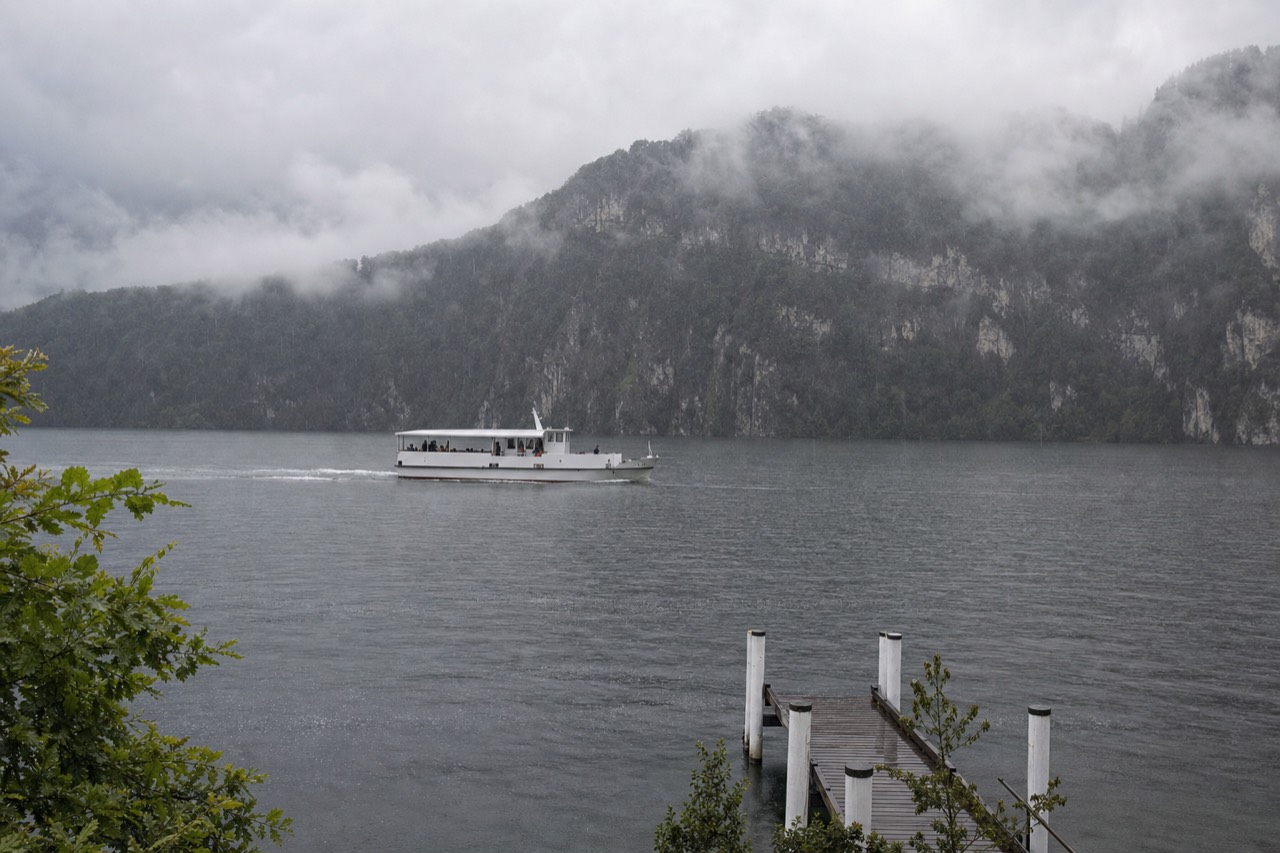
Switzerland gets rain in every month of the year. That is the honest starting point, and anyone promising you a guaranteed dry week is selling something. What the country does have is a rhythm: a wetter stretch from late spring into early summer, a drier late summer, and a grey, damp tail end to the year. For travelers headed to Lucerne, that rhythm matters more than any single label, because the lake sits in a basin ringed by mountains and the weather can shift between the town quay and a summit ridge in the space of an hour.
What is the rainy month in Switzerland?
There is no single rainy month, but the wettest period in most of the country, Lucerne included, runs from May through June, when frequent thunderstorms build over the Alps in the afternoons. A second wet spell arrives in November, when low cloud and drizzle settle into the lowlands. July and August see plenty of storms too, while February tends to be the driest month of the lowland year.
If you want the pattern in one breath: winter is cold but relatively dry at lake level, spring ramps up the showers, early summer peaks, and autumn tapers into grey. The reason is geography. Warm, moist air pushing north from the Mediterranean meets the Alpine wall in late spring and early summer, gets forced upward, and dumps its moisture as afternoon thunderstorms. The same mechanism that makes June green also makes June unpredictable.
November earns its gloomy reputation differently. It is not dramatic rain, it is low stratus, drizzle, and fog that can sit over the lakes for days while the peaks above enjoy sunshine. Locals call the inversion effect a blessing in disguise: you can stand shivering in grey Lucerne and know that fifteen minutes up the Pilatus cable car, the sky is blue.
For planning purposes, treat "rainy month" as a range rather than a date. If your dates are fixed in May or June, plan around rain rather than hoping past it. If they are flexible and you want the best odds of dry lake weather, the sweet spot for the Lucerne region is late summer into early autumn, when the storms have quieted and the air is still warm enough for a deck seat.
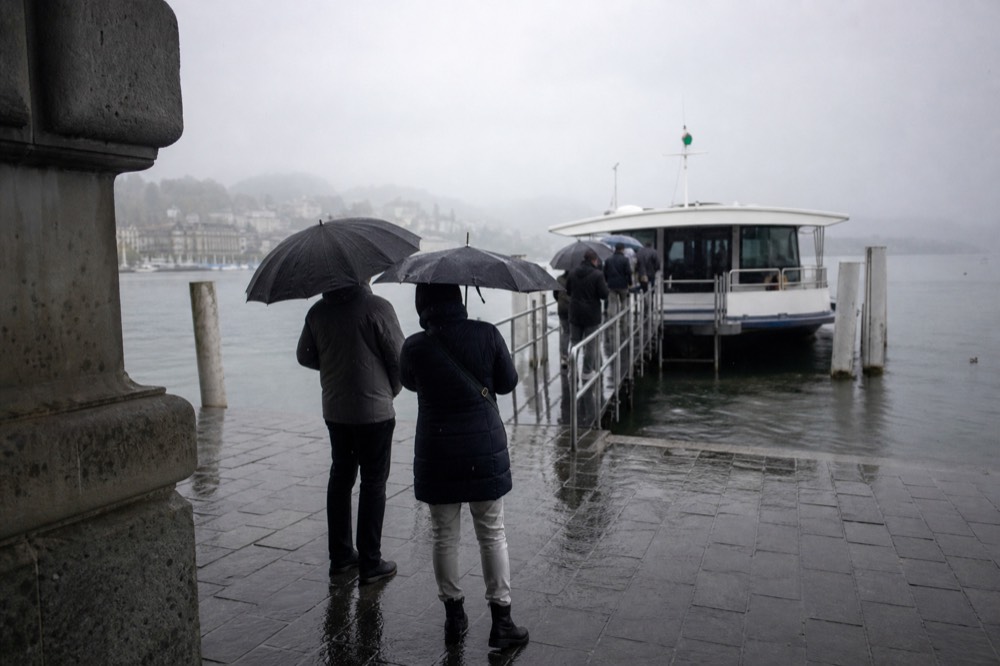
The good news for this site's readers is specific: rain does not stop the boats. Scheduled Lake Lucerne services run year-round with only a reduced winter timetable, and the sightseeing cruises operate in all weather. A wet forecast in Lucerne is a wardrobe problem, not a cancellation problem.
Does rain actually stop Lake Lucerne cruises?
Almost never. The Lake Lucerne Navigation Company, the official operator, runs scheduled boats year-round with a reduced winter schedule, and its sightseeing cruises operate in all weather. Only extreme meteorological conditions let the operator reschedule or cancel a sailing, and ordinary rain, even steady rain, does not come close to that threshold. Covered salons and 2nd-class restaurants sit at deck level on most vessels.
There is a detail in the operator's terms that travelers should know before they book, because it surprises people. Poor or inclement weather is not, by itself, a valid reason for a customer-requested cancellation or refund. In other words, if you decide a drizzly afternoon is not your idea of fun and you simply do not show up, you are unlikely to get your money back. The flip side is that the operator itself may reschedule or cancel a sailing in genuinely extreme conditions, and in that case you are covered.
The practical takeaway: book the cruise you want, dress for the sky you get, and let the boat do its job. Rain on the lake is not a ruined view, it is a different view. Mist on the Rigi, low cloud snagged on the Pilatus ridgeline, and the water turned pewter-grey are the conditions that make photographers happy and give the historic steamers their most atmospheric sailings.
Wheelchair users and travelers with limited mobility should know that all SGV steamboats and motor vessels are wheelchair accessible, with the single exception of the electric motor vessel Rütli. Main decks and 2nd-class restaurants are accessible at ground level, and an accessible WC is available on every vessel except that same Rütli. One accompanying person travels free with a valid SBB identification card for travelers with disabilities.
Wondering which cruise still delivers when the sky is wet?
The full-day Pilatus loop is the one I would pick for a changeable forecast, because it bundles the lake crossing with two mountain transports and a summit, and the boat leg alone justifies the day. It has drawn strong reviews from thousands of past guests, and it is the kind of excursion that reshapes itself around the weather rather than being spoiled by it. Before you commit to a date, it is worth checking the operator's live listing for current availability, since this one is noted as likely to sell out in peak season.
That is the booking side settled. Now the question is what the day itself looks like when the forecast is honest with you and admits it plans to rain.
The reason this combo suits uncertain weather is redundancy. The cruise from Lucerne toward Alpnachstad gives you an hour of shoreline regardless of cloud, the cogwheel train climbs through forest that looks moody and cinematic in rain, and if the summit is socked in you still get the descent by cable car over Fräkmüntegg with views opening and closing between showers. On a clear day it is the best-value big excursion from Lucerne. On a wet day it is a very good one.
Is rain in Switzerland the same everywhere?
No. Switzerland packs at least three rainfall regimes into a country smaller than some national parks. The southern side of the Alps around Ticino gets Mediterranean-style downpours, the western lowlands are the wettest of the flat regions, and the inner Alpine valleys, including parts of the Valais, are surprisingly dry. Lucerne sits in the pre-Alpine zone, which means changeable weather and frequent showers from May to June.
This is the part of Swiss weather that first-time visitors underestimate. You can drive an hour and change climate. The Valais towns in the Rhône valley receive so little rain that vineyards and even apricot orchards thrive, while at the same moment Locarno can be getting a tropical-style deluge. The Federal Office of Meteorology and Climatology, MeteoSwiss, publishes current measurements and climate normals for every region, and it is the source to check when you want real numbers for your exact dates rather than a blogger's generalities: MeteoSwiss, the Swiss federal weather service.
For a Lucerne-based trip, the useful framing is not "will it rain" but "when will it rain." In the early-summer wet period, showers are typically afternoon events. Locals plan boat trips and ridge walks for the morning and keep museums, restaurants, and covered boat salons in reserve for after two o'clock. If you structure your day the same way, a June forecast of scattered showers costs you almost nothing.
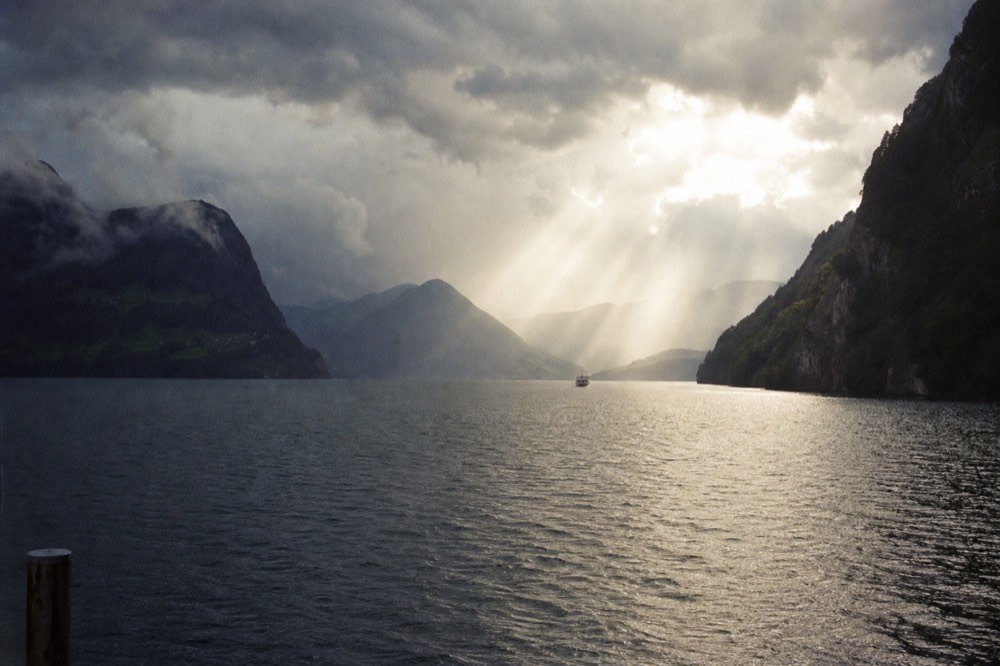
The lake itself modifies the local picture. Water holds heat and releases it slowly, so shoreline towns like Weggis and Vitznau, both reachable by boat in roughly an hour or less from Lucerne, often sit just below the cloud line in autumn while the peaks above them are in bright sun. Sailors and boat crews read that inversion almost instinctively.
What should you actually do in Lucerne when it rains?
Treat rain as a routing instruction, not a stop sign. The best rainy-day moves in Lucerne are the ones the weather cannot touch: a one-hour sightseeing or panoramic cruise in a covered salon, the Pilatus cogwheel train through dripping forest, the Chapel Bridge and old town arcades, and the Transport Museum. Scheduled boats run year-round, so a wet afternoon still has a lake in it.
The mistake travelers make is treating a rainy day as a lost day and retreating to the hotel. The second mistake is treating a rainy day as a hiking day above the treeline, which can be genuinely unsafe when trails are slick and cloud kills visibility. The middle path is the right one: get on the water, get under cover, and let the low cloud do its dramatic thing around you.
Here is how the main options stack up when the forecast turns wet:
| Rainy-day option | Why it works in rain | What to know |
|---|---|---|
| One-hour sightseeing or panoramic cruise | Covered salons, heated decks, runs in all weather | Great value; the shoreline looks moody and cinematic in mist |
| Pilatus boat, cogwheel train and cable car loop | Forest climb and lake crossing are rain-proof; summit views are a bonus | Check the live listing for seasonal operating dates |
| Old town arcades and Chapel Bridge | Covered walkways, cafés, watch shops | The bridge itself is best in low light and thin crowds |
| Swiss Museum of Transport | Fully indoors, lake-adjacent | Strong pick for families on a wet afternoon |
| Steamboat culinary cruise | Restaurant on board, water-level windows | Steamers run mainly in summer season, check the timetable |
One thing worth saying plainly: rain in Switzerland is usually not the all-day monsoon kind. It is showers, often brief, often heavy, often followed by startling clear light. Carry a compact rain layer rather than a full expedition shell, and you will find that the showers interrupt your day less than the queue at the Chapel Bridge photo spot.
If you are weighing the whole question of whether a lake cruise justifies the ticket at all, the honest breakdown, including what the weather does to the experience, is in our take on whether the Lake Lucerne cruise is worth it. The short version: on a wet day the covered-salon cruise is one of the few activities in the region that loses almost nothing.
How should you pack for a rainy month in Switzerland?
Pack for showers, not for a downpour marathon. The core kit is a genuine rain shell, one warm mid-layer for boat decks and summit stations, shoes with real grip, and a small umbrella for town. Skip the heavy waterproof boots unless you are hiking; boat decks, train platforms and old-town cobbles stay manageable in ordinary walking shoes with decent tread.
The layering advice matters more than the rain advice. A Swiss day in May or June can hand you four seasons between breakfast and dinner, and the deck of a moving boat is always windier and cooler than the quay you boarded from. On the catamaran and panoramic yacht cruises, the covered cabin is comfortable in rain, but the outdoor bow seats, the ones everyone wants, turn cold fast once the boat is underway. A light fleece under a rain shell solves both problems.
For the Pilatus loop specifically, remember that the summit station sits well above lake level and can be ten degrees cooler than Lucerne with wind on top. The cogwheel train and cable car are enclosed, so you only need the warm layers for the viewing platforms and any walk you do up top. If cloud has the summit closed in, those layers are what let you wait it out, because mountain cloud often breaks in waves rather than sitting permanently.
Footwear is where visitors over- and under-shoot at the same time. Heavy waterproof boots are overkill for boat decks and paved old towns. Thin-soled sneakers are worse, because wet boat stairs and platform gratings get slick. A pair of broken-in shoes with a grippy sole is the answer for nearly every scenario on this site, from the one-hour catamaran cruise to the Weggis lakeside path.
When is the best time to visit if you want to avoid the rain?
The driest, most reliable window for the Lucerne region is late summer into early autumn, roughly August through September, when the early-summer storm peak has passed and the November greyness has not arrived. February is typically the driest month at lake level but comes with short days and a reduced winter boat timetable. If your dates fall in May or June, book flexible activities and plan mornings on the water.
The trade-off is that the statistically drier months are not automatically the better months. August and September bring stable weather and warm lake water, but also the busiest quays. May and June bring the showers and, in exchange, the greenest meadows, fuller waterfalls, and the start of the paddle steamer high season. Some travelers would take green and unpredictable over dry and crowded without hesitating.
If you want the full decision framework, including how the seasons change the cruise experience, we have written a dedicated month-by-month guide covering shoulder-season pricing and the winter timetable in more depth than this rain-focused piece can.
One seasonal detail that most first-page search results miss: the historic paddle steamers, five of them in the fleet, dating from 1901 to 1928, run primarily in summer, and their season extends deep into autumn. For 2026, the steamer Stadt Luzern is scheduled to run until 18 October, and the Uri, the oldest of the fleet, runs special winter-themed trips in November and December. In other words, the two months most people write off for weather are precisely when some of the most atmospheric sailings happen.
Common questions about rain in Switzerland
The short answers: Switzerland's wettest stretch is May and June, rain does not stop Lake Lucerne boats, refunds are not granted for rain alone, the south gets the heaviest downpours, and a rain shell plus grippy shoes cover almost every wet scenario. The details behind each answer follow below.
What is the rainy month in Switzerland?
There is no single one. The wettest period in most of the country, including Lucerne, is late spring and early summer, with May and June bringing the most frequent showers and afternoon thunderstorms. November is the second damp stretch, more drizzle and low cloud than dramatic rain. February is typically the driest month at lake level.
Does rain cancel boat cruises on Lake Lucerne?
Practically never. The operator runs scheduled services year-round and its sightseeing cruises operate in all weather. Only extreme meteorological conditions allow the operator to reschedule or cancel a sailing. Ordinary rain, even steady rain, is normal operating weather.
Can I get a refund if it rains on my cruise day?
Not for rain alone. The operator's terms state that poor or inclement weather is not, by itself, a valid reason for a customer-requested cancellation or refund. If the operator cancels or reschedules a sailing due to extreme conditions, that is a different situation and covered separately.
Which Swiss region gets the most rain?
The southern Alpine side around Ticino takes the heaviest downpours, in a Mediterranean pattern, while the inner Alpine valleys such as the Valais are among the driest parts of the country. Lucerne sits in the pre-Alpine zone, which means changeable weather and frequent showers in the May-June window.
What should I pack for a rainy day in Lucerne?
A real rain shell, one warm mid-layer for boat decks and mountain stations, and shoes with genuine grip for wet stairs and platforms. Skip heavy waterproof boots unless you are hiking, and skip thin-soled sneakers, which are worst of all on slick surfaces.
Is November a bad month to visit Lake Lucerne?
It is grey at lake level, but not a write-off. Low cloud and drizzle often sit below bright summit sunshine, and the 2026 season includes special winter-themed steamer trips on the Uri in November and December. Pack for fog, plan a summit, and the month has a mood that many visitors end up loving.
If you have read this far, you already know the secret: the rainy month in Switzerland is real, but it is the least of your problems when the boats run all year. The last pick below is the one I would hand a friend who booked a June trip and then saw the forecast.
The panoramic yacht deserves the final word here because it is the rain-proof answer to the question this article asks. One hour, a covered salon with water-level windows, and a shoreline that looks its most dramatic with mist on the hills. Whether you arrive in the stormy green of June or the grey calm of November, the boat leaves the quay either way, and the lake does not care what the calendar says. That is the real answer to Switzerland's rainy month: it exists, it is May through June with a November echo, and it has never once stopped the lake from being worth your afternoon. More on planning the whole trip, rain or shine, is at Lake Lucerne Boat Cruises. Pack a real itinerary around it with our what not to miss in Lucerne guide, and if you are choosing between Lucerne and its rival lake town, our Lucerne-versus-Interlaken comparison weighs the weather too.